
Tech Neck: What Constant Phone and Laptop Use Is Doing to Your Spine
Tech Neck: What Constant Phone and Laptop Use Is Doing to Your Spine

If you’re reading this on your phone right now, stop for a second and notice your posture. Chin jutting forward? Shoulders rounded? Head tilted down? You’re not alone — and you’re not imagining the ache that comes with it. Welcome to tech neck, one of the fastest-growing musculoskeletal problems among desk workers in New York City and beyond.
This isn’t a minor inconvenience you can stretch away with a quick shoulder roll. Left unaddressed, tech neck sets off a chain reaction that can permanently reshape your spine — and the warning signs are showing up earlier and more severely with every passing year of screen time.
What Is Tech Neck, Really?
Tech neck (sometimes called “text neck”) describes the cumulative damage caused by holding your head in a forward, downward position for hours at a time while looking at phones, laptops, and tablets. Your head weighs roughly 10-12 pounds in a neutral position. But for every inch it tips forward, the effective load on your cervical spine multiplies — at a 60-degree tilt, the angle most people use when texting, your neck is straining to support what feels like 60 pounds of pressure.
Multiply that by the 4-7 hours a day the average office worker spends hunched over a screen, and you have a recipe for serious structural damage.
Why Posture Affects More Than Just Your Neck
Here’s what most people don’t realize: posture isn’t just about how you look. It’s directly tied to how your entire body functions. Poor posture can make you feel worse almost instantly, and good posture is consistently linked to better physical and mental health. If you’re dealing with any of the following, forward head posture may be the hidden cause.
Trouble breathing? A slumped, forward posture compresses your diaphragm and rib cage, restricting your lung capacity. Fixing your posture opens up your chest and allows for fuller, deeper breaths.
Frequent headaches? When your head shifts forward, it restricts blood flow and oxygen delivery to your brain while straining the muscles at the base of your skull. Correcting your posture can improve circulation and ease tension-related headaches.
Upper back tension? This one is simple physics. The further forward your head translates, the more tension gets placed on your upper back musculature to hold it up. Your trapezius and rhomboid muscles are essentially working overtime, all day, every day.
Shoulder pain? Rolled-forward shoulders — a hallmark of tech neck — pull directly on your upper back and destabilize the shoulder joint itself, setting the stage for chronic pain.
Pain at the base of your skull? This is one of the most common tech neck complaints we see. Forward head posture overloads the suboccipital muscles at the skull’s base, and fixing your posture takes direct strain off both your traps and these small but powerful muscles.
The Real Danger: What’s Happening Inside Your Spine
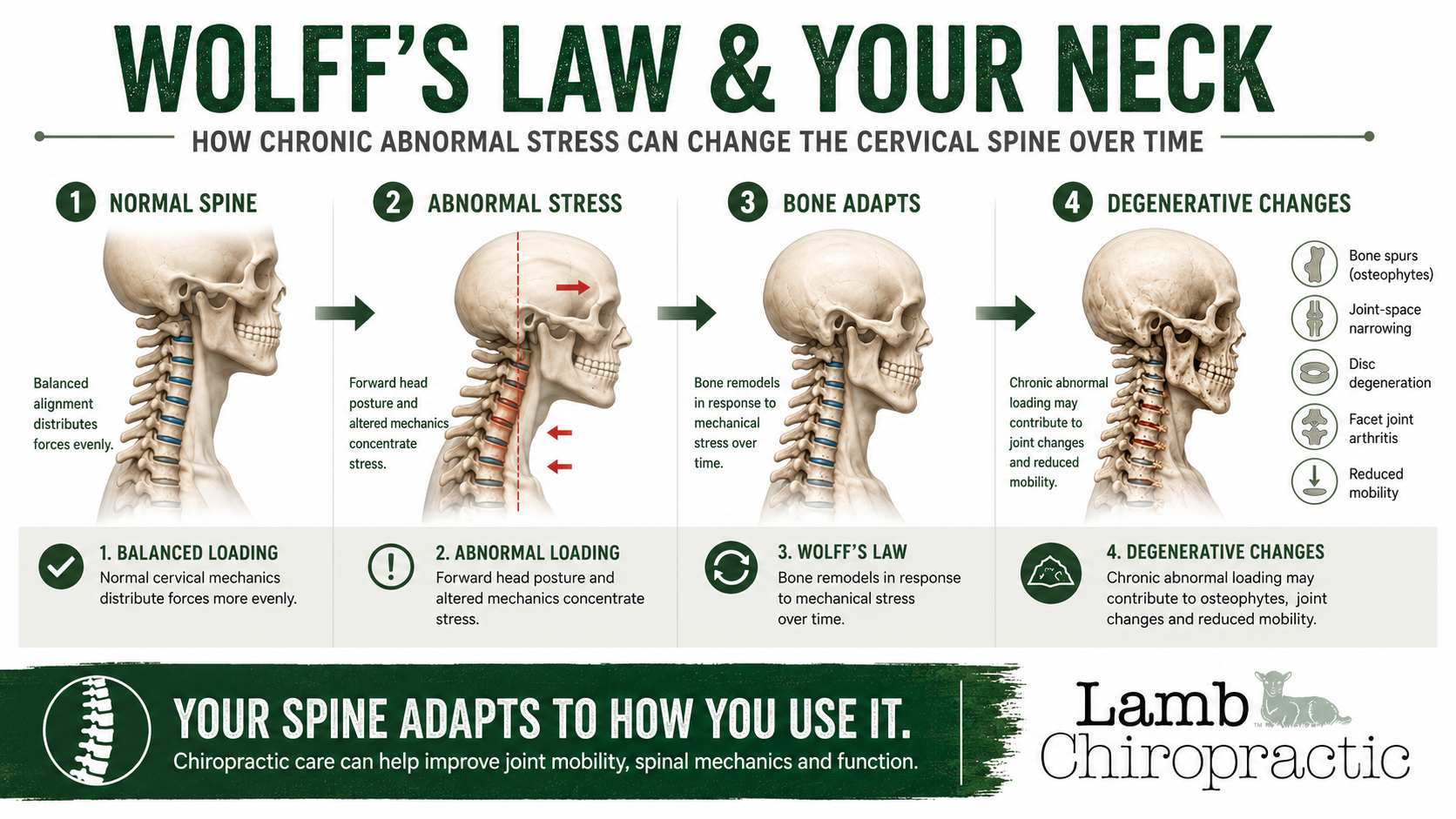
The aches and pains are your body’s warning system. What’s happening underneath is far more concerning.
When you repeatedly place abnormal forces on your spinal joints, your body responds with inflammation. If that abnormal loading continues — as it does for anyone spending years hunched over devices — your body starts a process governed by Wolff’s Law: bone remodels itself in response to the mechanical stress placed on it.
In simple terms, your spine adapts to constant negative pressure by laying down extra calcium deposits at stress points. Over time, this contributes to arthritis, bone spurs, and permanent structural changes — changes that are far more difficult to reverse than the muscle tension that started the whole cycle.
Beyond the bone itself, sustained poor posture also places abnormal pulling and stretching forces on your spinal cord and the nerve root sheaths that branch off it. This excessive tension is what leads to the pain, numbness, tingling, and loss of function in the arms and hands that so many tech neck sufferers experience. And the constant pressure on upper back musculature and joints doesn’t just contribute to arthritis — it also promotes fatty tissue deposits in the area, which create further irritation and perpetuate the cycle of inflammation.
One important clarification: none of this structural, cumulative damage is related to how long a chiropractic adjustment “works” or “holds.” Tech neck damage develops over years of repetitive strain — it has nothing to do with the duration of relief from any single treatment.
How to Protect Your Spine Starting Today

The good news is that tech neck is highly preventable, and early-stage damage is very treatable. Here’s where to start.
Bring your devices up to eye level. Whenever possible, hold your phone up rather than looking down at it. Phone stands, laptop stands, and book stands are inexpensive tools that keep your device closer to eye level and take the strain off your cervical spine.
Raise your monitors and TV. Position screens slightly above eye level rather than below it. This small adjustment combats the constant downward head position that defines tech neck posture.
Limit your screen time where you can. This one is obvious but worth saying: the less time you spend in a forward-head position, the less cumulative stress your spine absorbs.
Consider corrective devices. Tools like the Posture Pump, used regularly, can help restore the natural cervical curve that forward head posture flattens out over time.
Be cautious with posture correctors. Wearable posture correctors can offer some benefit, but they’re a passive fix. Targeted exercises, stretches, and corrective chiropractic care are almost always more effective long-term — and considerably more comfortable than wearing a brace all day.
How Dr. Lamb Approaches Tech Neck Treatment
Dr. Lamb doesn’t just adjust patients and send them on their way. Every tech neck patient receives a customized set of exercises designed to restore the cervical curve, correct forward-slumped shoulders, and address the ergonomic habits that caused the problem in the first place. This combination of hands-on care and take-home corrective work is what separates lasting results from temporary relief.
Because our office sits at 315 Madison Avenue, directly across from Grand Central Station and One Vanderbilt, we see this exact pattern every single day — commuters and office workers who spend their mornings hunched over a phone on the train and their afternoons hunched over a laptop at a desk. Tech neck isn’t a hypothetical for our patients. It’s the reality of working in Midtown Manhattan.
Tech Neck FAQ
How do I know if I have tech neck? Common signs include a forward-jutting chin when you’re relaxed, chronic upper back or shoulder tension, headaches that start at the base of the skull, and stiffness after long periods on your phone or laptop. If your ears sit noticeably in front of your shoulders when you look in a mirror, that’s a strong indicator of forward head posture.
Can tech neck be reversed? In its early stages — mostly muscle tension and inflammation — yes, tech neck responds very well to corrective exercises, stretching, and chiropractic care. Once bone remodeling and calcium deposits have formed under Wolff’s Law, full reversal becomes harder, which is why early treatment matters.
How long does it take to fix tech neck posture? It varies by patient and how long the poor posture has been present, but most people begin noticing reduced tension and improved cervical curve within several weeks of consistent corrective exercises and chiropractic care. This is separate from how long any single adjustment provides relief.
Do posture correctors actually work for tech neck? They can offer temporary support, but they’re a passive fix. Active correction — targeted exercises, stretching, and chiropractic adjustments that address the underlying cause — tends to produce more effective and more comfortable long-term results than wearing a brace all day.
What’s the ideal screen height to prevent tech neck? Phones should be held up near eye level rather than viewed downward, and computer monitors or TVs should sit slightly above eye level. This keeps your head in a neutral position and reduces the load on your cervical spine.
Is tech neck only a problem for young people? No. While it’s often associated with teens and heavy phone users, tech neck is extremely common among office workers of all ages, especially anyone who spends multiple hours a day on a laptop or commuting while looking down at a phone.
Don’t Wait for the Damage to Become Permanent
Muscle tension is reversible. Inflammation is reversible. But once Wolff’s Law kicks in and calcium deposits begin forming along your cervical spine, you’re dealing with structural changes that are far harder to undo. The earlier you address tech neck, the more treatment options you have.
If you’re experiencing headaches, upper back tension, shoulder pain, or discomfort at the base of your skull, don’t chalk it up to “just stress” or a bad night’s sleep. Your posture may be the root cause — and it’s fixable.
Ready to find out what your posture is doing to your spine? Schedule a posture and spine assessment with Dr. Adam Lamb at Lamb Chiropractic today. We’ll evaluate your cervical curve, identify the ergonomic habits driving your symptoms, and build a plan to reverse the damage before it becomes permanent.
Email lambchiro@gmail.com
IG @lambchiro FB lambchiropractic